





ARTICLES:
Wheelchair-Accessible Taxis in 2004!
by Jean Ryan
DIA Website - A New Look
by Jean Ryan
HIV/AIDS and People with Disability
by Nora Ellen Groce
March 2004 Election Day Survey of NY Polling Sites Finds Lack of Access
Disabled In Action Sues Green Bus Lines & NYC DOT
by Dave Reynolds
Can Disabled People be Forced to Crawl Up the Courthouse Steps?
by Adam Cohen
Public Housing's Difficult Future
by Julia Vitullo-Martin
Timothy's Law and Mental Health Insurance Coverage
New MTA Half-Fare Application Available
Medicaid Buy-In Offer Has Few Takers So Far
by Joel Stashenko
Feds Fine Delta for Wheelchair Allegations
by Russell Grantham
High Court Interested in Theater's ADA Case
by Laurie Asseo
Justice Department Announces Consent Decree with AMC Entertainment, Inc.
Reading Frieda's Book
by Bob Feinstein
Nomination of Philip Bennett for Outstanding PCA of 2003
Oh, Jerry - A Song in Memory of Jerry Nuzzi
words by Danny Robert
by Jean Ryan
 |
| We Don't Fit! |
| Photo by Philip Bennett |
| D (Link opens in a new browser window) |
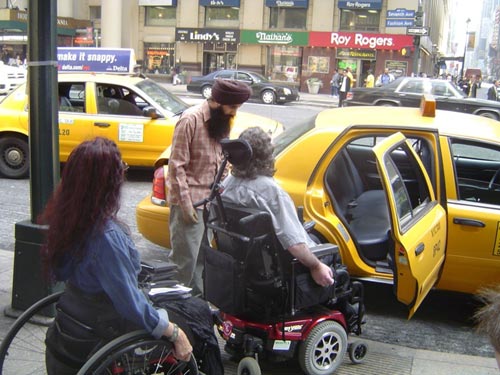
We need to get places reliably, fast, and spontaneously. This year we want a firm, definite plan for 100% accessible taxis, the whole fleet and not just a few.
The fight for accessible taxis has heated up on several fronts recently. The several recent "solutions"
which have been given to us without our input by the Bloomberg administration have not noticeably made our lives better, and have only served to remind us that we need more options for transportation, and we need them now. Right now to get around NYC, we basically have buses, Access-A-Ride, wheelchairs and walkers, crutches and canes, and our own legs, if possible. None of these choices are fast and spontaneous, especially over long distances.
 |
| Taxi! |
| Photo by Philip Bennett |
| D (Link opens in a new browser window) |
Obviously, we have a great need for 100% access to the subways, and that requires elevators in all stations (not just key stations) and to have the gap problem solved. The New York State Comptroller, Alan Hevesi, issued an audit report in January 2004, and recommended that the MTA use bridge plates for wheelchair access. The MTA disagrees. (For the report, go to http://www.osc.state.ny.us/audits/allaudits/093004/01s69.htm)
 |
| Roll-In Line, Waiting for a Taxi Photo by Chris Pierson D (Link opens in a new browser window) |
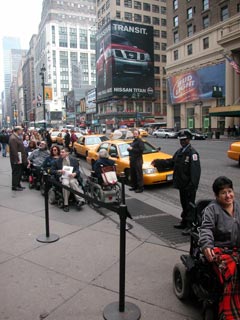
Intro. 84, Margarita Lopez' accessible taxi bill in the City Council, has 38 sponsors at the time of this writing in early May, but so far, Councilmember John Liu, chair of the Transportation Committee, and Gifford Miller, speaker of the council, have not signed onto it. Intro. 84 would gradually provide 100% wheelchair access to yellow taxicabs within about 5 years. Anything less would not be practical at all. Remember, there are only 5 accessible taxis now out of over 12,000 cabs, and where are they when we need them? One taxi dispatcher we spoke to at Penn Station has been working there for two years and has only seen one accessible taxi out of the constant stream of taxis he sees.
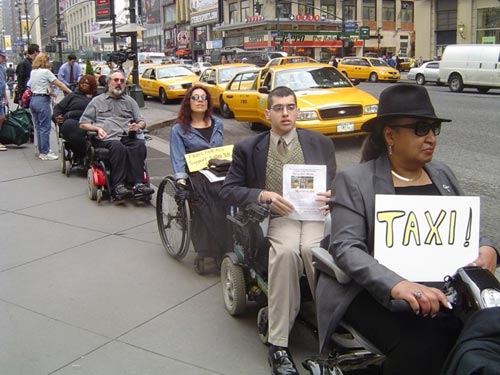
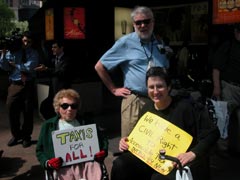
To call attention to Intro. 84 and gain sponsors, the Taxis For All Campaign and DIA members as well as other disability rights advocates have lobbied city council members through phone calls, in person wherever we see them and at Stated Meetings (held every 2 weeks at City Hall). We attended the two Taxi and Limousine Commission (TLC) auctions at the New School on April 16th and April 23rd and earlier TLC hearings. At the beginning of the last auction, about ten DIA members protested the sham of designating 27 taxi medallions for wheelchair-accessible vehicles when we will actually end up with none from the auctions!
The 81 accessible taxis we are supposed to get over a period of three calendar years have evaporated into nothing. But it wouldn't have been enough, anyway. We need all taxis to be accessible.
 |
| At the Roll-In Demonstration Photo by Chris Pierson D (Link opens in a new browser window) |
The medallion auction sale has brought in more than 150% of what the City expected for its coffers. The average price was $344,000 for a corporate medallion and $293,000 for an individual medallion. The cab industry has just demonstrated that it is very wealthy and it feels that the business of operating a taxicab is a very profitable and worthwhile investment. There may be an opportunity to use some of the extra money to reestablish a conversion fund for owner-drivers in order to ease the passage of the accessible taxi bill.
The activists at the individual-owner medallion auction chanted,
"What do we want?"
"Accessible taxis!"
"When do we want them?"
"Now!"
The room was filled with:
ACCESSIBLE TAXIS NOW!
 |
| Meeting at the end of the Roll-In Demonstration Photo by Chris Pierson D (Link opens in a new browser window) |
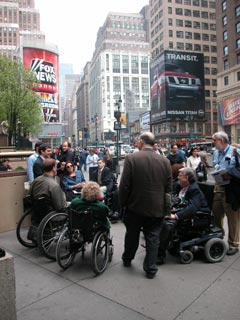
As expected, the police appeared and pushed our activists out of the auditorium, but our activists kept returning to the auditorium through the many doors until they were finally forced to leave the building. Our voices were heard and the TLC and politicians can expect more actions and more press coverage of our issues in the future.
Activists were also at the Penn Station taxi stand on Seventh Avenue on April 22nd, the day before the last taxi medallion auction, protesting our lack of taxi access and demonstrating to the press and the thousands of people passing by that we could not take taxis because they are not wheelchair accessible.
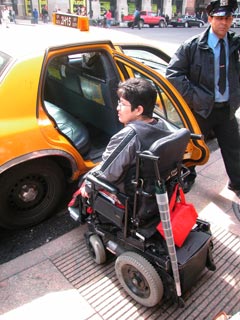
It is clear that we need action now to get 100% taxi access for the 65,000 wheelchair and scooter users in New York City and the many visitors with disabilities who flock here for tourism and business. An accessible taxi would only cost about $2,000 more than a new taxi sedan does now. That is peanuts compared to the hundreds of thousands of dollars that each medallion went for in the auction. Small change!
People without disabilities will also benefit by having increased leg room as well as room for children in strollers, pets, luggage, and other large items. People with disabilities will actually be able to travel with their families and friends, too, instead of traveling separately as they have to do now. Accessible taxis will also be used for back-up transportation when our wheelchairs breakdown or when we get stranded by Access-A-Ride or have a taxi authorization given instead of a van ride.
 |
| Hey, I need a taxi! Photo by Chris Pierson D (Link opens in a new browser window) |
Instead of supporting 100% accessible taxis, the Bloomberg administration's Mayor's Office for People with Disabilities (MOPD) and the TLC offered us the supposed panacea of A Ride For All, the wheelchair-accessible car service set up last fall exclusively for people with disabilities. It was set up without our input. They were doing this for us, not with us. But separate is not equal, and the necessity to call a week to a few days instead of 10 minutes ahead of time does not make this a spontaneous service. In addition, A Ride for All is struggling to stay afloat and has recently had to lay off 2 drivers. It also does not run at night. Owner Les Jacobs says he could stay in business and expand if the TLC would enforce their regulation that says every car service base has to have an accessible vehicle or contract for one. That's debatable because accessible car service under the TLC regulation has to be just as available for people with disabilities as for nondisabled people with no extra calling or waiting.
Why not make all car services have accessible vehicles so the access is all over the city and it would be available on a quick basis? Intro. 73 would accomplish this. We need movement on this, too, from the City Council, as well as a ferry bill that would require 100% accessible ferries, slips, piers, and shuttle buses.
Disabled In Action and the Taxis for ALL Campaign will not rest until we have a law mandating 100% wheelchair-accessible yellow taxicabs for New York City, and we're determined that the law will be passed in 2004. We will be meeting with Gifford Miller and John Liu about this as soon as possible to seek their support, and by the time this paper is out, we probably will have had a mass meeting of the Taxis For All Campaign members to work on further actions to reach our goal of having taxis that truly are for everyone.

DIA's website has a fresh new look! Come and see for yourself at http://www.disabledinaction.org/. We have revised the website to be more user-friendly so you can immediately find what you are looking for. At the top of the home page on the left is our logo with DIA attached to a shooting star in a black circle with a light blue border. Across the top is a big blue and black banner that says DISABLED IN ACTION of Metropolitan New York. It's snazzy yet simple, just what we want in a website.
On the left of each page is a navigation bar where you can find information about DIA and the One-Step Program as well as the DIA Singers. We even have an interactive One-Step form you can securely fill out and e-mail to Irma Shore, the One-Step Program director. If you prefer to do it on paper, you can print the form out and mail it in. You won't be able to join DIA or renew and pay dues online, but you can print out a form to mail if you want to join DIA or renew your dues. The DIA Activists are also on our site, and they are archived back to 2001. We have photos, too, and links to other organizations and publications. If you can't remember when a meeting is, you can easily look it up online.
We also have an announcements page. All the more reason to keep checking back to see what's new!
Kudos to Nadina LaSpina who designed and maintained the previous DIA website for many years. It was a lot of work, and we thank Nadina for all her efforts. Now, Nadina has moved on to other ventures and we have a new web designer and webmaster.
Our new web designer and webmaster is Douglas Pucci, a recent computer science graduate of New York University's College of Arts and Science. He enjoys visual aspects of computer work, especially graphic design, computer art, and web design, and he is interested in designing websites for other organizations. His interests besides computers are watching sports of all kinds and reading, especially newspapers.
One of the most important aspects of our website is that we strive to have it accessible to people with all kinds of disabilities. Some people have low vision or are blind. We have big fonts with high contrast, and we describe photos. There are special things that have to be done, codes to be written, so that blind people can access our site with various types of readers. Other people with disabilities can see well but cannot use a mouse or a keyboard.
Douglas has been using two sites to make the DIA website more accessible to people with disabilities: BOBBY (http://bobby.watchfire.com/) and Cynthia Says (http://www.cynthiasays.com/). Over the past few years, various groups of web experts have worked out guidelines for web accessibility to people with disabilities and these two sites help web designers follow those principles. None of these programs are infallible, so if you experience problems with the DIA website, please e-mail Douglas and he will try to adjust the website so you can access it.
by Nora Ellen Groce
The Lancet, vol. 361, April 26, 2003, p. 1401-1402 - Although AIDS researchers have studied the disabling effects of HIV/AIDS on previously healthy people, little attention has been given to the risk of HIV/AIDS for individuals who have a physical, sensory, intellectual, or mental health disability before becoming infected. It is commonly assumed that disabled individuals are not at risk. They are incorrectly thought to be sexually inactive, unlikely to use drugs, and at less risk for violence or rape than their non-disabled peers. Yet a growing body of research indicates that they are actually at increased risk for every known risk factor for HIV/AIDS. For example, in a recent article, S. Blumberg and W. Dickey analyze findings from the 1999 US National Health Interview Survey and show that adults with mental health disorders are more likely to report a medium or high chance of becoming infected with HIV, are more likely to be tested for HIV infection, and are more likely to expect to be tested within the next 12 months than are members of the general population.
Such findings should not be unexpected for individuals with disability. There are significant risk factors for disabled populations around the globe. For example, despite the assumption that disabled people are sexually inactive, those with disability-and disabled women in particular-are likely to have more sexual partners than their non-disabled peers. Extreme poverty and social sanctions against marrying a disabled person mean that they are likely to become involved in a series of unstable relationships. Disabled individuals (both male and female) around the world are more likely to be victims of sexual abuse and rape than their non-disabled peers. Factors such as increased physical vulnerability, the need for attendant care, life in institutions, and the almost universal belief that disabled people cannot be a reliable witness on their own behalf make them targets for predators. In cultures in which it is believed that HIV-positive individuals can rid themselves of the virus by having sex with virgins, there has been a significant rise in rape of disabled children and adults. Assumed to be virgins, they are specifically targeted.
In some countries, parents of intellectually disabled children now report rape as their leading concern for their children's current and future well-being. Bisexuality and homosexuality have been reported among deaf and intellectually disabled adults, while awareness of HIV/AIDS and knowledge of HIV prevention is low in both these groups. Individuals with disability are at increased risk of substance abuse and less likely to have access to interventions. It is estimated that 30% of all street children have some type of disability and these young people are rarely reached by safe sex campaigns. Furthermore, literacy rates for disabled individuals are exceptionally low (one estimate cites an adult literacy rate of only 3% globally, thus making communication of messages about HIV/AIDS all the more difficult. Sex education programs for those with disability are rare, and almost no general campaigns about HIV/AIDS target (or include) disabled populations. Indeed, where AIDS campaigns are on radio or television, groups such as the deaf and the blind are at a distinct disadvantage.
The future for disabled individuals who become HIV positive is equally grim. Although little is known about access to HIV/AIDS care, disabled citizens receive far fewer general health-services than others. Indeed, care is not only often too expensive for impoverished disabled persons, but it can also be physically inaccessible-for example, clinic steps bar the way for a wheelchair user and consultation with a physician without a sign-language interpreter is meaningless for most deaf persons.
Currently, little is known about HIV/AIDS and disability. Only a few studies have estimated prevalence and no prevalence data exist for any disabled populations from sub-Saharan Africa, Asia, Europe, Central and South America, or the Caribbean. However, a growing number of stories from disability advocates worldwide point to significant unreported rates of infection, disease, and death. Over the past decade there have be a handful of articles on HIV/AIDS pilot programs and interventions for intellectually disabled adults or services for deaf adolescents. Many of these projects are innovative but almost all are small and underfunded. There is a real need to understand the issue of HIV/AIDS in disabled people in global terms and to design and implement programs and policy in a more coherent and comprehensive manner. The roughly 600 million individuals who live with a disability are among the poorest, least educated, and most marginalized of all the world's peoples. They are at serious risk of HIV/AIDS and attention needs to be focused on them.
In January, 2003, the World Bank and Yale University, started a global survey on HIV/AIDS and disability that seeks to better understand variables of the current epidemic as well as to identify best-practice interventions and grassroots efforts. Organizations that serve people with HIV and disability are invited to participate in the survey. International respondents are especially welcome.
Contact:
Nora Ellen Groce, Global Health
Division, Yale School of Public Health,
Yale University, New Haven, CT 06520,
USA; e-mail: nora.groce@yale.edu.
Imagine coming out on election day, going to your polling site to vote for the candidate of your choice and finding that the ramp provided for you is unsafe and you can't get in. Perhaps you use a cane or a walker and the step that greets you at the entry way to your polling site is without a railing and so high that you can't negotiate it. Or perhaps the site you vote at is accessible but the gate into the site's accessible entrance is locked and no one is around.
Closed doors, locked gates, unsafe ramps, dim lighting and confusing signage greeted many New Yorkers with disabilities who wanted to vote on March 2 in the presidential primary, according to a polling site survey in Manhattan done by the Center for Independence of the Disabled in New York (CIDNY).
This survey, the second by CIDNY, again spotlights problems that keep many of the 1.8 million eligible New York voters with disabilities from accessing their polling sites. And for the second time since November when the original survey was done, CIDNY is asking Board of Elections Commissioner John Ravitz to remedy the access problems at these sites, identify any others and fix them too.
"New Yorkers who are eligible to vote should not have to worry about getting inside their polling sites and being able to see the voting machine. Access is their right. The irony is that some of the remedies to the problems we identified are no or low-cost and are easy to implement. Problems like appropriate signage, unimpeded entryways, good lighting and safe ramps, are not difficult to accomplish."
says Susan Dooha, Executive Director of CIDNY. "Since we gave our November election day survey indicating access problems to Commissioner Ravitz in early January, we assumed from his assurances that at least these sites would be improved. Clearly that didn't happen at ten of the sites we revisited for this survey."
At the same time, survey teams went out to the upper west side and upper east side to take a snapshot of more polling sites. "Unfortunately, the same problems we found in November, exist in other parts of the city as well,"
says Sharon Shapiro-Lacks, Director of Advocacy, "Of the 38 new sites surveyed during this election day, 22 had access problems. We don't understand why the Board of Elections is not monitoring the City's polling sites for compliance, and we particularly don't understand why, when problems are pointed out, the Board of Elections doesn't resolve them."
As the 2004 Presidential Election nears, the Center for Independence of the Disabled in New York is [again] asking Commissioner Ravitz [Executive Director, New York City Board of Elections] for written assurance that voters with disabilities will have access to their polling sites.
In a letter to the Commissioner, Ms. Shapiro Lacks says, "Each and every one of the 1.8 million New Yorkers with disabilities must have the opportunity to vote at the polls. We fully expect that you will inspect and remedy the access problems at these sites as well as at all the other polling places around New York City."
by Dave Reynolds
April 30, 2004 - Inclusion Daily Express - New York, New York -- A group of bus riders with disabilities have filed a class action lawsuit against Green Bus Lines, along with the City of New York, for providing "grossly inadequate"
service and violating state and federal anti-discrimination laws.
The suit was filed in U.S. District Court Tuesday by Martin J. Coleman, Esq., on behalf of a group of individual riders and the advocacy group Disabled In Action of Metropolitan New York.
In the suit, Green Bus Lines is accused of failing to follow the Americans with Disabilities Act, the New York State Human Rights Law, and the New York City Human Rights Law, according to Anthony Trocchia, President of Disabled In Action. The New York City Department of Transportation is also named in the suit because it is responsible for overseeing privately-run bus companies.
"The service is horrendous,"
Trocchia told Inclusion Daily Express in an e-mail.
The private bus company is accused of having many buses with no wheelchair lifts or lifts that are broken; buses that can only accommodate one wheelchair user; and a lack of emergency evacuation procedures for wheelchair users. The plaintiffs also claim that bus drivers are disrespectful to riders with disabilities and that the company does not take seriously complaints made by those riders.
New York City Transit, the main transportation provider in the city, is scheduled to take over Green Bus Lines and the other 6 privately run bus companies on July 1.
"Their bus service is great,"
Trocchia said of NYCT. "However, it will take two years for NYCT to replace the junky buses of the seven companies."
"Disabled folks cannot be expected to put their lives on hold. Our transportation needs must be met."
Trocchia commented that the city has given the private bus lines millions of tax dollars in subsidies over the years, and that taxpayers' money has been wasted in the process.
Inclusion Daily Express readers learned about Anthony Trocchia last July, when he staged an impromptu "rush hour"
protest in front of a Green Lines bus.
After Trocchia had waited through four Green Line buses without a working lift, he parked his electric wheelchair in front of the bus -- at one of the busiest intersections in Queens -- and refused to move.
Trocchia then pulled out his cell phone and called newspaper and television stations to report his own act of civil disobedience.
Editor's Note: Very soon the Supreme Court will issue a ruling in the Tennessee v. Lane case. We should all be on pins and needles until the ruling is in. It will affect every one of us.
CAN DISABLED PEOPLE BE FORCED TO CRAWL UP THE COURTHOUSE STEPS?by Adam Cohen
New York Times - Benton, Tennessee - January 11, 2004 -- When George Lane showed up at the Polk County Courthouse with a crushed hip and pelvis, he had a problem. His hearing was on the second floor, there was no elevator, and the judge said he had better get upstairs. Mr. Lane, both of whose legs were in casts, somehow managed to get out of his wheelchair and crawl up two flights of stairs. "On a pain scale of 1 to 10, it was way past 10,"
he says.
While Mr. Lane crawled up, he says, the judge and other courthouse employees "stood at the top of the stairs and laughed at me."
His case was not heard in the morning session, he says, and at the lunch break he crawled back down. That afternoon, when he refused to crawl upstairs again, he was arrested for failing to appear, and put in jail.
Anyone looking for evidence that a mean mood has descended on the nation need only stop by the Supreme Court Tuesday for the arguments in Tennessee v. Lane. Mr. Lane and other disabled people are suing Tennessee under the Americans With Disabilities Act for failing to make its courthouses accessible.
Tennessee, backed by a group of other states, is belittling the claims, and insisting it has immunity to the suit.
Incredibly, there is a real chance the Supreme Court will side with Tennessee. The court's conservative majority has been on a misguided "federalism"
campaign, denying Congress's power to protect the environment, combat gun violence and ban discrimination. It has justified these rulings by saying it has to protect the "dignity"
of the states. The discrimination in Mr. Lane's case is so horrific, however, it may help the court to grasp the possible consequences of that stand - including its effect on the dignity of people like Mr. Lane. George Lane was working two jobs when he got into the car accident that led to his court appearance. Mr. Lane, who had had minor run-ins with the law before, was not popular with the courthouse crowd in his rural Tennessee county.
The employees who laughed at him offered to carry him upstairs, he says, but he was afraid they would intentionally drop him. (The judge who presided that day is no longer alive; the court clerk says she was not present.)
A second plaintiff, Beverly Jones, supports her two children by working as a court reporter. Ms. Jones, who uses a wheelchair, has turned down jobs in some of the 23 Tennessee counties without accessible courthouses. Once, in a court without an accessible bathroom, she says, the judge had to pick her up and place her on the toilet. Another time, one of the court employees carrying her upstairs slipped. By chance she fell into someone else, she says, but she nearly fell all the way down.
Ralph Ramsey, a third plaintiff, was a defendant in a civil suit. When he got to court, he sent word to the judge that his disability prevented him from getting to the second-floor courtroom. The case went on without him. An opposing attorney later came down and told Mr. Ramsey, as he passed by, that his client had just won a $1,500 judgment against him.
In their briefs, the states show little sympathy for the disabled plaintiffs. Court reporters like Ms. Jones have no constitutional right, they say, to "ply their trade"
in accessible courthouses. Nor, they insist, does Mr. Lane have an absolute right to attend his own criminal trial. As support, they cite a case in which a defendant was removed after repeatedly interrupting his trial and threatening to kill the judge. In any case, the states argue, Tennessee offered to "assist him upstairs,"
the offer Mr. Lane rejected because he feared he would be purposely dropped.
But their main argument is states' rights - that the federal government has no power to protect the disabled this way. The states insist the 11th Amendment gives them immunity from suits for damages under the A.D.A. They cite the Supreme Court's own declaration that to force the states to defend themselves against these lawsuits would deny them "the dignity that is consistent with their status as sovereign entities."
This interpretation of the 11th Amendment is wildly inconsistent with its plain language, which bars only lawsuits against states brought by "citizens of another state, or by citizens or subjects of any foreign state."
But conservatives on the Supreme Court, who insist in other contexts that they are "strict constructionists,"
have held that the amendment also limits suits brought by a state's own citizens. Even John Noonan Jr., a conservative federal appeals court judge appointed by President Ronald Reagan, has called the link between the 11th Amendment and state immunity "imaginary"
- and dangerous.
As off base as the Supreme Court's states' rights rulings have been, they have prompted little popular outrage. The doctrines are too obscure for most people to follow, and "respect the power of Congress"
is not much of a rallying cry. But these decisions have deprived Americans of important protections, like the Violence Against Women Act and the Gun-Free School Zones Act. And they have made it easier to discriminate against older workers, blind people and cancer victims.
The 50th anniversary of Brown v. Board of Education is this year. In Brown, the Southern states argued that whatever anyone thought about segregated schools, the federal government did not have the power to order them to integrate.
The Supreme Court unanimously disagreed, holding that blacks had the right not to be discriminated against by virtue of their national citizenship. Now, the court should do the same thing for the disabled. Tennessee may be willing to turn them into, as Mr. Lane puts it in his brief, "a second class of citizens who lack the full and equal opportunity to participate in civic life."
But the court should make clear that as Americans, if not as Tennesseans, people like George Lane, Beverly Jones and Ralph Ramsey have the right of full entry into the halls of justice - and first-class citizenship.
by Julia Vitullo-Martin
January 14, 2004 - New York Sun - One of the largest and most serious housing and development issues in New York City receives almost no attention in the press: and that's public housing. It only gets extensive coverage when something bizarre or potentially violent occurs, or better yet, both. For example, the press immensely enjoyed writing about the full-grown male Bengal tiger and the 5-foot-long crocodile that were discovered in October living in a 5-bedroom apartment in the Drew Hamilton Houses in Harlem.
Yet by any objective measure, the New York City Housing Authority is important and huge. With its 345 projects holding 181,000 units and housing about 175,000 families, it owns one of every 13 rental units in the city. And the demand for its housing is impressive: Over 146,000 families are on its waiting list.
NYCHA is by far the largest American housing authority, managing one out of every seven public housing units in the country. And because New York, unlike most cities, deliberately sited its projects throughout the city, including in middle income neighborhoods, it now has many low-income, sometimes decaying projects smack in the middle of gentrifying development. (New York thereby avoided the far greater calamity of excessive concentration of low-income, non-working households in neighborhoods from which working families then flee.)
Some projects, such as the landmarked Harlem River Houses in Manhattan and the Williamsburg Houses in Brooklyn, make good neighbors. They are well maintained and reasonably well managed. Others, such as Coney Island Houses, have nearly destroyed their neighborhoods with violent crime, drug dealing, and rampant vandalism.
Good neighbors or bad, all NYCHA projects face a difficult future. The federal government, which has often played a ruinous role in public housing, has pretty much settled on a strategy of capped funding toward local authorities. In other words, while authorities will continue to get some federal funds, they have for several years been under increasing pressure to cover their expenses with rental income, just like any landlord.
In particular, the federal "modernization"
funds that paid for capital improvements have been seriously restricted. This would be fine if public authorities were also allowed, like private landlords, to make their own decisions about tenant eligibility, rent levels, eviction policies, rehabilitation standards, etc.
NYCHA has the resources and properties on its own to make some profitable transactions that could subsidize its poorer tenants. But, of course, authorities such as NYCHA have long labored under the whims of the federal government, whose decades of contradictory and coercive federal policies have undermined the original high ideals behind public housing.
The idea of the 1937 Wagner-Steagall Act was to free working families from their dark, primitive, disease-ridden, overcrowded tenements, and house them instead in clean, if austere, modern buildings engineered with modern plumbing. Tenants were to pay a modest rent, 25% of their income, while accumulating enough savings to make a down payment on homes of their own. Public housing, much like the Depression's public assistance, was thought to be transitional.
Even before the 1937 Wagner-Steagall Act, NYCHA erected the first government-built -and -financed housing project. First Houses, a masterfully rehabilitated row of old tenements on the Lower East Side, was completed in 1936. However,the genius of its design lay in a principle that NYCHA and all other housing authorities quickly abandoned. Every third tenement was demolished, thereby admitting the light and air that had always been missing, before the remaining tenements were extensively rehabilitated.
First Houses is in good shape today because NYCHA has cared for it well and, though NYCHA officials deny any favoritism, they have not housed their most troubled families there. Of First Houses' 168 residents, 23% are minors. Indeed, 47% of the 112 families in First Houses are headed by people 62 years or older. Only 14% of the families are on welfare as compared with 21% of all NYCHA families.
NYCHA has fought hard against bitter opposition by advocates in New York and bureaucrats and politicians in Washington, D.C. to maintain income diversity and working families in its projects. This is in startling contrast to nearly every other big city system. These systems became housing of last resort primarily for the desperately poor with no place better to go. An impressive 38% of NYCHA families work. Yet here's the long-term problem: The average rent for all households is $302, which cannot possibly cover proper repair and maintenance.
Even if national politics were to change substantially, producing both a Democratic president and Democratic Congress, federal policies will probably never again favor generous subsidies to housing authorities. Because everyone has known this for a long time, most cities have responded by demolishing bad projects and taking advantage of federal programs, primarily Hope VI, that reward privatization efforts.
Proudly abstaining from large-scale demolition, saying all its projects are sound, NYCHA has barely dipped its toe into Hope VI. Hope VI funding requires projects to be scaled down in size or density and replaced with low-rise, preferably owner-occupied townhouses, sometimes mixed with renters. (NYCHA has one Hope VI program in Far Rockaway, in Queens, and another in Ocean Hill-Brownsville, in Brooklyn.) Yet NYCHA is the one authority in which privatization has a chance of working because NYCHA owns good properties in good neighborhoods.
During the first Bush administration, the secretary of Housing and Urban Development, Jack Kemp, passionately espoused home ownership for public housing tenants. However, he made a serious miscalculation that the tenants did not make. The housing he wanted to sell them was undesirable. He ineptly tried selling bad properties in bad neighborhoods to poor people, who lacked the income to make ongoing mortgage payments, much less cover capital improvements.
NYCHA has a different situation altogether. It owns good properties, and it has many hard-working, ambitious, potentially home-owning households, who would make good neighbors in a mixed-income development. Old-fashioned, ugly projects mar many neighborhoods in New York. The federal government has offered one way out via Hope VI, a first step to privatization and home-ownership.
A group of concerned activists in New York State have been working together to get the state legislature to adopt Timothy's Law which would mandate mental health insurance parity. The law would provide for the same level of insurance coverage for mental illness as for physical illness instead of limiting coverage to a certain amount of visits per year.
The State Assembly passed Timothy's Law but the Senate has yet to pass it, so advocates have organized a "phone-in"
on May 18th, 2004, to state senators and also to State Majority Leader State Senator Joseph Bruno. Readers can participate by calling the Senate switchboard at 518-455-2800 and asking to be connected to your senator and to Senator Bruno. Tell your senator that you support Timothy's Law (Senate Bill 5329) and ask them to ask Senator Bruno to bring Timothy's Law to the floor for a vote now! You may also contact Senator Bruno directly at 518-455-3191 or at bruno@senate.state.ny.us.
According to the Timothy's Law website (http://www.timothyslaw.org): "Some may say that it will be too expensive, but it has been proven otherwise. A recent actuarial study conducted by Price Waterhouse Coopers estimates that the passage of Timothy's Law would only increase premiums by $1.26 per employee per month. Furthermore, a recent Zogby poll showed that 81% of New Yorkers said they were willing to pay the estimated $1.26 more per month for full insurance coverage for chemical dependency and mental health care needs."
Not everyone is convinced of the benefit of mental health care, but people should be able to get it if desired.
Early in January, 2004, the MTA began to mail copies of its new and simplified Reduced Fare Application to mental health programs that receive funding from the New York City Department of Health and Mental Hygiene ("DOHMH").
For those who are eligible for the Reduced Fare, there has never been a better time to apply. Anyone who has a disability can apply for the Reduced Fare Metrocard. You cannot use it on Access-A-Ride but you can use it on MTA buses and subways. Here are some of the ways in which you can apply.
Apply In Person
Visit the MTA's Reduced Fare Office at 370 Jay Street, Room 934, Brooklyn, NY 11201.
The office is open Monday through Friday from 7 a.m. to 11 p.m., and on weekends from 9 a.m. to 5 p.m.
MTA Reduced Fare Staff will help you to complete the Application and will take your photograph free of charge. Remember, all information people supply to the MTA will be kept strictly confidential. For more information you can call (212) METROCARD, or (212) 638-7633.
People with hearing impairments can call 718-596-8273 (TTY/TDD).
Apply by Mail
Pick-up a copy of the new Reduced Fare Application at the MTA's Brooklyn office, or at the MTA's offices at 347 Madison Avenue, or get one from any mental health agency that is funded by DOHMH, or print out an application from the MTA website at http://www.mta.nyc.ny.us/nyct/fare/pdf/disabled.pdf
Applications are not yet available at subway token booths.
The Simplified Procedures:
Responding to concerns raised by many people, the MTA has sought to streamline the process:
No Medical Certification
People who apply based upon their eligibility to receive Supplemental Security Income benefits ("SSI"), coupled with serious mental illness, will NOT need to submit a medical provider certification with the initial Reduced Fare Application. You will, however, be required to state the name of your health care provider.
Computer Matching For Eligibility
When the MTA receives an Application it will check with the Social Security Administration's ("SSA") database to confirm that the Applicant is listed in the SSA's database as being an SSI recipient and having a serious mental illness. If so, the MTA will process the Application and issue a Reduced Fare Card.
If for any reason the SSA is unable to confirm this information, the Applicant will still be permitted to file a Medical Certification form with the MTA and upon receipt, the application will be processed.
Mobile Sales Outreach Available to Visit Your Site
The MTA has indicated that it will make its Mobile Sales Outreach Unit available to visit your mental health program or any other large gathering of people to help people apply for the Reduced Fare. To schedule an appointment, call 718-521-3037, and the Unit will explain its procedures and put you on the list.
You can also visit the Metrocard Van or Bus which will come to your neighborhood from time to time. Information about schedules and locations are on the web at http://www.mta.nyc.ny.us/metrocard/mcbus.htm or you can call 718-243-4999 or 212-METROCARD for more information.
Now is the time to help people gain access to more affordable transportation. Please call me if you have any questions about the Reduced Fare.
Fred A. Levine
Law & Public Policy Consulting
131 Perry Street, Suite 2A
New York, NY 10014-6210
Telephone number: 212.352.3100
Fax number: 212.352.1527
by Joel Stashenko
AP - January 7, 2004 - Albany Times Union -- One of the most insistent lobbying campaigns in recent years in Albany was on behalf of disabled New Yorkers who wanted to keep working full time while receiving Medicaid health insurance coverage.
Six months after the state began allowing people to "buy in"
to the Medicaid program by paying premiums, only about 1,000 of an estimated 20,000 eligible New Yorkers have applied for enrollment.
According to the state Health Department, 720 individuals have been approved for the program so far.
"There has been a particular problem in getting word out in New York City, where the enrollment is noticeably less than the people proportionately who are out there,"
said Harvey Rosenthal of the New York State Association of Psychiatric Rehabilitation Services. The National Alliance for the Mentally Ill-New York State said it also appears some local social services workers have not been properly informed about the program and how to enroll beneficiaries in it.
State Health Department spokesman Rob Kenny said Tuesday that state officials are getting hundreds of applications for the program each month. Information about the program was posted for the first time Tuesday on the department's Web site (http://www.health.state.ny.us), Kenny said.
Under the Medicaid program, which was approved by Gov. George Pataki and the Legislature in 2002, disabled individuals can earn up to $46,170 a year and couples or families up to $61,870 a year and continue to qualify for Medicaid if they pay premiums. The premiums could reach $2,000 a year, depending on income.
The program also allows beneficiaries to have up to $10,000 in assets and still qualify for Medicaid. Enrollments in the buy-in program were to begin on April 1, 2003, but were delayed until July 1 because of what state Health Department officials said were computer problems.
Some people said beneficiaries were being presented with a difficult choice -- reduce their income or stop working entirely so they can continue to receive Medicaid, or lose health coverage.
by Russell Grantham
November 14, 2003 - Atlanta Journal-Constitution - Delta Air Lines agreed to a $1.35 million civil penalty for failing to provide adequate help to passengers using wheelchairs.
The Department of Transportation said the Atlanta airline's fine is the largest so far for alleged violations of the 1986 Air Carrier Access Act.
"We found it was a serious violation,"
DOT spokesman Bill Mosley said.
However, Delta will only have to pay the government $100,000 if it reduces complaints from passengers with disabilities and spends at least $1.25 million to improve services.
The DOT said Delta failed to provide wheelchairs in some cases, or was slow to help passengers, or left passengers stranded in wheelchairs or on planes for extended periods. Under terms of the deal, Delta did not admit to the allegations.
Since March, the DOT has fined 10 carriers under the act. Previously, the largest was a $1.2 million fine levied on American Airlines. Last month, the DOT assessed a $125,000 penalty against AirTran Airways, the Orlando-based discount carrier that has its flight hub in Atlanta.
The DOT typically agrees to cut the fine dramatically if the airline agrees to spend a certain amount on better service to passengers with disabilities.
Delta spokesman John Kennedy said the carrier is spending more than the required $1.25 million, including $2 million on a computer training system to make employees and airport contractors more familiar with the requirements of the law. He said Delta was also the first to create a manager position to monitor compliance with the law.
"Delta is fully committed to meeting the terms of the order,"
said Kennedy.
The DOT said Delta's fine was based on a "significant number of apparent violations"
revealed during an investigation of passenger complaints filed with the DOT and Delta from 2000 to 2002.
The law requires airlines to help passengers on and off planes, to have space reserved to store wheelchairs, and to promptly deal with complaints.
Editor's Note: In March, 2004, DOT settled with Northwest Airlines on similar complaints, fined them a smaller amount, and returned most of the money to them so they could retrofit airplanes to fit manual wheelchairs and make other changes. I sometimes travel, and even when airlines have closet that fit manual a manual wheelchair, it is often a huge struggle to make them use them for that purpose. When you are traveling, you can always insist that the airline immediately contact their CRO, Conflict Resolution Officer to intervene, or you can complain to the DOT hotline at 1-800-778-4838. Bring this number when you travel. They are there 7 days a week.
by Laurie Asseo
(Bloomberg News) Denver Post - January 13, 2004 - The U.S. Supreme Court signaled interest in an appeal by a Regal Entertainment Group unit on whether a disability-rights law bars movie theater stadium-style seating that forces people in wheelchairs to sit near the front row. The court sought the Bush administration's views on the case.
Regal Cinemas, part of the world's largest movie-theater chain, is appealing a ruling it says will impose "devastating"
costs on companies that have built thousands of theaters in which most seats must be reached by climbing stairs. AMC Entertainment Inc. and Loews Cineplex Entertainment Corp. support Regal's appeal.
Stadium-style theaters have rows of tiered seating to allow a clear view of the screen. The theaters have several rows of non-tiered seating in front, and, in the absence of ramps, patrons in wheelchairs usually must sit in that area. Federal rules enacted under the Americans With Disabilities Act require wheelchair areas to provide "lines of sight"
similar to those for other patrons.
A lower court ruling means thousands of movie theaters "must now be destroyed or expensively retrofitted,"
lawyers for Regal said in court papers filed in Washington.
The ADA bars discrimination against the disabled in employment, government services and in public accommodations such as restaurants and movie theaters.
Washington, D.C. - The Justice Department filed a consent decree on November 14, 2003, regarding alleged disability rights violations by AMC Entertainment Inc. and AMC Multi-Cinema, Inc. (collectively known as AMC).
The consent decree, filed in the U.S. District Court for the Central District of California and which still needs court approval, resolves matters regarding inaccessible restrooms, entrances and exits to theaters, parking facilities, counters, as well as other barriers to accessibility for persons with disabilities in AMC stadium-style movie theaters.
Under the terms of the consent decree, AMC will fix the twelve stadium-style theaters surveyed by the Justice Department. AMC has also agreed to survey and make similar improvements in over eighty additional stadium-style movie theaters across the country. These modifications include providing accessible wheelchair seating locations with the proper number and configuration of companion seats, providing the requisite accessible restroom stalls and other restrooms features, making routes into and within the auditoriums accessible to those who use wheelchairs, adding accessible parking, purchasing a sufficient number of assistive listening devices for people who are hard of hearing, adding proper signage, as well as making corrections to many other aspects of the theaters.
The U.S. District Court for the Central District of California will further decide on the issue of remedies related to AMC's failure to provide lines of sight from wheelchair seating in stadium-style movie theaters that are comparable to those offered to the general public. Litigation about remedies for failure to provide comparable lines of sight for wheelchair locations at AMC stadium-style theaters remains stayed pending resolution of a ruling by the U.S. Court of Appeals for the Ninth Circuit in a related case.
The Justice Department began a nationwide investigation of AMC's stadium-style theaters in November 1996 after receiving complaints from persons with disabilities who were denied access to seats in several theaters.
Individuals interested in finding out more about the ADA or the agreement can call the Justice Department's toll-free ADA Information Line at (800) 514-0301 or (800) 514-0383 (TDD), or access its ADA website at http://www.ada.gov
Source: adapted from http://www.usdoj.gov/opa/pr/2003/November/03_crt_622.htm
Editor's Note: This article is adapted from one written by Jonathan Rand. It illustrates a problem all of us have had getting stranded at one time or another.
JONATHAN RAND COMPETES IN THE NYC MARATHON AND DISCOVERS THAT NOTHING MUCH HAS CHANGED FOR TRANSPORTATION ACCESS
In November, 2003, Jonathan Rand, with the NYC Achilles Track Club, rode his motorized scooter in the wheelchair division of the New York City Marathon. Jonathan noted that "The run was uneventful. The adventure began that evening."
After doing the marathon, Jonathan, a severely disabled man who uses an electric scooter, went out to eat with friends hoping that the only problem of the day would be the inaccessible bathroom at the restaurant.
A flat tire caused the scooter to stall on a curb-cut and a familiar scenario for Jonathan began to play out as his friends, and then passers-by, tried to think of what to do to get him home.
In the confusion, he didn't remember the new accessible car service program called "A Ride For All" announced by Mayor Bloomberg only a few days before, and neither the police nor the person at the "non-emergency" service number, 311, knew anything about this.
In the past, strangers had to rescue Mr. Rand any way they could. One of the first things they think of is to call the number that's printed on the back of the scooter! But last time someone called that number, at about 11:45 at night, the company complained that they woke the guy up and he was very annoyed! Supposedly, they only offer "road service"
to people with oxygen tanks that run out or have malfunctioned. Something as "minor"
as a flat tire far from home, for someone who's severely disabled with cerebral palsy and nonverbal, isn't enough of an emergency in their minds.
The police have no accessible vehicles for transporting the scooter. The fire department also declined. "We only put out fires!"
And an ambulance will only take you to the hospital without your scooter because ambulances are not wheelchair accessible!
This time, a woman even called Access-A-Ride, the city's paratransit van service for the disabled, and was told that since she couldn't prove Jonathan was qualified and registered for their service, they wouldn't help. When she asked them what they would do if the police asked them to come and get him, they said, "I don't care who you ask!"
but since they have to have a reservation at least a day before, they would not be able to help him anyway.
Finally, two of Jonathan's friends determined that their van, parked quite a distance away, was in fact available and someone was driving it uptown from the Village to bring him and his wounded electric scooter home.
Taking the bus wasn't an option because in addition to the fact that the scooter almost wouldn't budge when someone was on it, this scooter, a four-wheeled model with a wide turning radius, doesn't fit on the bus! But Medicaid won't approve three-wheeled scooters because "three-wheeled scooters tend to tip over on the bus!"
Go figure!
When Jonathan complained about the Medicaid regulations, someone told him to go to Washington and complain
Do you think they expect him to walk there?
by Bob Feinstein
One of the most difficult problems of being blind is how isolating a disability it can be. Struggling with this reality for as long as I can remember, I always strive to find ways to make life more interesting.
I am a member of an online discussion group called Disgaytalk, which is associated with a Webzine called Bent: A Journal of Cripgay Voices (bentvoices.org). Thanks to my involvement with Disgaytalk, I became friends with BENT's editor, Bob Guter, who invited me to write for BENT. About two years ago we also set up regular phone reading sessions. Bob is a phenomenal reader, and we have enjoyed books on subjects ranging from ice-skating, to the Holocaust, with an emphasis on biographies and stories of different disabilities.
When I heard that Frieda Zames, someone I have always admired, had written a book with her sister Doris about disability, I wanted to read it, even though its title (The Disability Rights Movement: From Charity to Confrontation) made me hesitate. I thought it might be dry at best and boring at worst.
On the contrary. Not only has it turned out to be crammed with information, it's fascinating and entertaining, too. It talks about different disabilities and traces milestones in how people worked to improve conditions for others. The authors provide pertinent historical background that enables you to discover how much work is involved to achieve even the simplest improvements in social justice, especially for those with sensory or motor impairments.
Truly delightful is how Frieda and Doris introduce pivotal players and incidents in the disability drama by sharing quotes and specific life experiences, thus adding a human dimension. For example, when talking about the new rolling cane, they explain how a traditional cane works for a blind person, and why so many (except me!) prefer the new rolling tip on the cane.
I am impressed at the exhaustive research that was necessary to write this book. When discussing the Braille system, for example, Frieda and Doris point out that it had its origins in military code, something few people know.
Every reader of this book can learn a great deal about disabilities and even gain a broader perspective on his or her own disability. I was intrigued to read about how the Independent Living movement originated. I recognized names of people who I knew virtually nothing about, like Anne Emerman, and Ed Roberts, and then learned about what they accomplished.
The book's coverage of F.D.R. really struck me. I had never realized what a job the press did in covering up the severity of his disability, and it made me understand the pressures he must have been under, not only as president during time of war, but as a person who had to pretend he was able bodied and could walk, when this was not the case. Bob and I often pause at spots like this to discuss our reactions.
I recommend this book to all DIA members, and to anyone who has a genuine interest in knowing more about the disability rights movement. It is a book that is easy to read, yet is packed with a great deal of information. The writing style is engaging, and I especially like the quotes from other books, or from people who are being featured.
Bob and I have quite a bit more to read. I look forward to those two or three hours a week when I call him, he puts on his headset, and the book comes alive. It is like having a friend visiting me, and for a time I forget that NYC can be an isolating, lonely place to live.
Bravo to Frieda and Doris!
P.S.
Carmelo Gonzalez and I are contributors to a new book called Queer Crips: Disabled Gay Men and their Stories, edited by Bob Guter and John R. Killacky (Haworth Press), which was just nominated for a Lambda Literary Award. We hope that it will be available in recorded form soon.
Editor's Note: Philip Bennett won the award for Outstanding PCA (Personal Care Attendant) of 2003 in the Concepts program. Congratulations, Philip! You are humble about winning, but you deserve it.
NOMINATION OF PHILIP BENNETT FOR OUTSTANDING PCA OF 2003
by Danny Robert
I am writing to nominate Philip Bennett (PA # 200170-5) for recognition as Outstanding PCA (Personal Care Attendant) of 2003 (or any other year). My name is Daniel Robert. I've been a Concepts member since 1992. I have twelve hours/seven days of attendant services. I've had a lot of PCAs since I joined Concepts -- all of them male. But I've never before taken the time or trouble to nominate anyone for this honor.
Before I joined Concepts, for the first two years of my home care award, I got ripped off in various ways by a bunch of PCAs, both men and women, all sent to me arbitrarily by conventional home care agencies. By the time I was sent a guy I really liked, I had found out about Concepts. I asked my guy if he would be willing to come with me over to Concepts, once I was judged to be sufficiently self-directed. He was willing, I was judged self-directed and we did become Concepts consumer and PCA.
He worked for me seven days a week for two more years. But he needed a break from time to time. So I hired Philip sometime in '92 to be my backup. I had met Philip at meetings of the disability rights organization (Disabled In Action [DIA]) that I had joined in 1991. We were both DIA members so he was both a colleague and my employee, which made for some problems back then. But we've worked through that and Philip has been doing his PCA thing for me on and off, part time, ever since.
Since my first guy left, I've had good and bad PCAs; a few were criminals or had criminal records; some I liked, some I detested; some were energetic, others were lazy; some were ambitious , others just did the work because it was easier than digging ditches or washing dishes... but I've never had a PCA like Philip Bennett, although it took me years to really learn to appreciate him for who and what he is.
Five months ago, the guy who had been working for me steady for the last five years - five or six days a week - just stopped coming to my house. His last day was May 31st, 2003. I never heard from him again. To be perfectly honest, when the smoke cleared, I was relieved that he was gone. I never really liked the guy. But without him I thought I was stuck. I had become so dependent on this person that I hadn't prepared myself for the possibility that he might quit someday. Philip, who had been working for me one or two days a week for quite a while, was my only backup.
When I told Philip that this other guy had disappeared, he was outraged. He immediately offered to work for me six days a week. If he hadn't been working for someone else on Saturdays, he would've offered to work seven days a week, rather then be responsible for making me stay in bed for a whole day. In fact, on a couple of occasions, he asked the other consumer's permission to come over to my house and get me up on a break and come back later and get me back in bed on another break.
The guy that left was taciturn, even silent most of the time. He blended into the woodwork like a snake in the grass. By contrast, Philip talks a lot. Sometimes, he talks too much. His disability is mental so he is kind of peculiar in some ways. He certainly doesn't blend in -- not ever, not to anything. He is unique. The main thing about Philip is that he is so passionate about PCA work. He's been doing it for almost 30 years. He is the only attendant I ever met who identifies himself proudly as a PCA. Of course being a PCA doesn't entirely define who he is. He has many other talents and many other interests.
Philip is a writer, a civil rights activist and a thinker. He likes to read newspapers and magazines and watch TV -- not so much to be entertained as to be informed. He's got lots of friends with whom he would like to spend time. He's got an aunt who lives with him and needs him and brothers and a sister who love him, and so forth.... But Philip has his priorities. To him nothing is more important than being somebody's PCA, as long as he respects that somebody, believes that she or he is doing good, important work in civil rights or in the arts. He proclaims for everyone to hear that he is proud to be my PCA -- proud to be assisting a proud disabled man like me.
Philip listens to me and does whatever I tell him to do. I, in turn, listen to him and try to be respectful when I ask him to do something -- most of the time. If I tell him to stop talking, he will stop. If I tell him to focus, he will focus. I'm not saying that Philip is perfect. Far from it. But he is way ahead of any other PCA I ever had working for me.
Sometimes, Philip recites "Romeo and Juliet" while he's emptying my colostomy bag. Sometimes he even sings Louis Armstrong songs or whole sections of "Marat/Sade" while he's catheterizing me. He knows pretty much everything there is to know about popular culture for the last forty years. He could beat almost anybody in a game of "Trivial Pursuit". His basic hours are 9 AM to 9 PM, but he will sleep over if I need to get up real early in the morning (like when I had to make a 6:30 AM Amtrak train to get to Washington for an ADAPT rally or when I have a 7 AM call as an extra on the set of a TV show or movie, which I do quite a lot).
I forgot to mention that on 9/11, even though he wasn't scheduled to work for me that day, he called me -- and everybody else he knows who uses attendant services just to make sure that everybody's PCA made it to work that day and that they were all right. On the night of this summer's blackout, after he got me into bed, Philip walked 60 blocks to the home of another disabled person just to see if she needed any help. Somehow he got to my place the day after the blackout, even though I didn't expect him to because it was so difficult to get anywhere. But he showed up so I didn't have to languish in bed even for one day.
I could go on and on but I think I've said enough. Philip Bennett is the only person I ever met who has a Calling to be a PCA (just like people who have a Calling to be nuns or priests). I admire him for that, and for everything else.
A SONG IN MEMORY OF JERRY NUZZI
words by Danny Robert
(to the tune of "O, Donna" by Richie Valens)
Verse I
I had a friend, Jerry was his name
Since he's been gone, our movement's not the same.
O, I miss my friend. Jerry, O. where can you be?
Refrain I
O., Jerry, you had a dream -- to unite all disabled as one,
To bring us together on ADA day, to march in the light of the sun.
Chorus -- O, Jerry O, Jerry O, Jerry
Verse II
Jer, you were strong, full of passion and pride.
I'm so glad to have known you, to have rolled at your side...
O, I miss my friend. Jerry , O. where can you be?
Chorus -- O., Jerry, O, Jerry, O, Jerry, O, Jerry
Verse III
Jer, you made it happen - DIDM wouldn't have been
If you hadn't moved mountains, determined to win.
O, I miss my friend. Jerry, O. where can you be?
Chorus -- O., Jerry, O., Jerry, O., Jerry, O., Jerry.
Refrain II
O, Jerry, you worked hard at 504, BCID.
Your vision was true; you fought the good fight.
You wanted all Crips to be free...
Chorus -- O., Jerry, O., Jerry, O., Jerry, O., Jerry.
Moving Right Along
Washington (Reuters) - October 27, 2003 -Two large U.S. car rental agencies on Monday agreed to improve airport shuttle bus access for disabled people renting vehicles at airports, settling a probe into possible disability rights violations, the U.S. Justice Department said.
Alamo Car Rent-A-Car LLC and National Car Rental System Inc. agreed to have within 60 days at least one shuttle bus at each company-owned location capable of carrying a person in a wheelchair or on a scooter between the terminal and the lot where the vehicles are kept.
The two companies, which were recently purchased by private equity firm Cerberus Capital Management, also agreed to ensure that all newly purchased or leased buses that carry 17 or more people are similarly equipped, as well as 10 percent of smaller buses, according to the Justice Department.
"We are pleased that Alamo and National have agreed to provide accessible airport shuttle buses between the airport terminal and rental lots,"
said Alexander Acosta, assistant attorney general for civil rights.
Alamo and National, which operate under the corporate name Vanguard Car Rental USA, have more than 3,200 rental locations in 83 countries.
"Our customers will be able to experience this expanded commitment within the weeks ahead,"
Jeff Parell, chief operating officer for Vanguard, said in prepared remarks.
Mayor Mike Bloomberg introduced a bill, Intro 417, earlier this year in an attempt to make the City's human rights law "substantially equivalent"
to the federal Fair Housing Act. The City Commission on Human Rights desired the change because they want, in this era of drastic budget cuts, to make themselves eligible for money from Washington to investigate fair housing cases.
Disability rights groups, including Disabled in Action, Eastern Paralyzed Veterans Association, and the New York Lawyers for the Public Interest, testified at an October hearing before the General Welfare Committee that the proposed legislation would considerably weaken protections for the disabled currently available under the city law. At that hearing, the administration withdrew support for the bill in its current forum.
Craig Gurian, who is now heading the Anti-Discrimination Center of Metro New York, offered an analysis of the problems with 417 and a substitute bill was drafted that would achieve the administration's goal of "equivalence"
without weakening city protections for the disabled. The substitute has yet to be introduced. Gurian was the principal drafter for the Human Rights Commission of the comprehensive 1991 amendments to strengthen the human rights law.
 |  |
| Lucy Birbiglia Getting an Award Photo by Antonnette Brumlik D (Link opens in a new browser window) | Anita Apt Getting an Award Photo by Antonnette Brumlik D (Link opens in a new browser window) |
An evening of disability awareness and recognition of achievement was held at City Hall on October 27, 2003, by NYC Comptroller, William J. Thompson, Jr.. Two DIA members were among the honorees, Lucy Birbiglia, a new DIA board member and Director of the Queens Independence Living Center (QILC), and Anita Apt of Queens.
Congratulations to both of you!
On Sunday, April 18, 2004, The Committee for Effective Leadership honored four individuals for their exemplary leadership and service to their community and to the Bronx, and Alexander Wood was one of the people honored. Alexander is director of the Disabilities Network of New York City and a DIA member. If you want to join the Disabilities Network, you can do so by calling Alexander at 212-251-4071. Way to go, Alexander!
In October, DIA members, Harry Weider and Frieda Zames received awards from the 504 Democratic Club during their annual dinner and program. Good work, Harry and Frieda! Frieda and Anne Emerman also received an award from the New York Statewide Senior Action Council.
In recognition of National Disability Employment Awareness Month 2003, the U.S. Department of Education, in partnership with the U.S. Chamber of Commerce, released a guidebook in October 2003 to acquaint business leaders with programs and resources available to assist them in hiring people with disabilities.
The jointly developed publication, "Disability Employment 101: Learn to Tap Your 'HIRE' Potential," includes information about how to find qualified workers with disabilities, how to put disability and employment research into practice and how to model what other businesses have done to successfully integrate individuals with disabilities into the workforce.
"People with disabilities, particularly those with severe disabilities, represent an often-untapped group of educated, highly skilled, talented and qualified workers,"
U.S. Secretary of Education Rod Paige said.
"At the Department of Education, our Office of Special Education and Rehabilitative Services administers several programs that support the goal of finding competitive, meaningful, integrated employment for people with disabilities."
"We are proud to highlight these resources and our partnerships with private employers, state governments, community-based organizations and others who, like the chamber, are working with us toward this important employment goal,"
Paige said.
Among other things, the 56-page guide provides information regarding department-funded vocational rehabilitation agencies, Disability and Business Technical Assistance Centers, and Centers for Independent Living. It also includes checklists and various other resources to aid employers as they prepare to employ people with disabilities.
During National Disability Employment Awareness Month 2002, the Education Department and the chamber's Center for Workforce Preparation began development of the booklet. A partnership was established to produce the document as a means to acquaint employers with the programs available at the department and the chamber that can help businesses employ people with disabilities.
Copies are available on-line and also will be available soon through the department's "ED Pubs" service on the Web at http://www.edpubs.org or by phoning 1-877-4-ED-PUBS, faxing 1-301-470-1244 or writing ED Pubs, P.O. Box 1398, Jessup, MD 20794-1398.
http://www.ed.gov/about/offices/list/osers/products/employmentguide
Margaret Gallagher, a member of DIA and also a member of the Executive Committee of the 504 Democratic Club, died on December 31st, 2003, following a fall. Margaret never gave up trying to change the status quo, and her feisty nature and cynical mind would push us to think of things in a different light, to see more angles, and to not give up.
Monroe, Maine - (March 23, 2004) -- AbilityMaine.org, the online newspaper of news, resources, and activism information on disability in Maine and the world, has branched out to promote literary writing by people with disabilities. On January 30, 2004, AbilityMaine launched Breath & Shadow, the only online literary journal with a focus on disability. The monthly publishes poetry, fiction, essays, interviews, drama, and other writing from the perspective of life with disability.
Originally the idea of AbilityMaine editor, Norman Meldrum, the project was taken up by award-winning poet and writer, Sharon Wachsler, whose humor columns have drawn readers to the online newspaper since February 2002. "I'm proud to be editing the sole cross-disability literary magazine written and edited entirely by people with disabilities,"
says Wachsler. "As a writer who has a disability, I know firsthand how frustrating it is to have my work turned down by editors who are confused or frightened by my life. A big part of the impetus for Breath & Shadow is to provide opportunities for other talented writers with disabilities to make their voices heard."
Startup funding for Breath & Shadow has been provided by Resources for Organizing and Social Change (ROSC) - the grassroots, nonprofit organization of which AbilityMaine is a part. "The people at ROSC and AbilityMaine have been fantastically supportive and integral to the project,"
says Wachsler. "However, it's the public's support that will keep us going."
Read Breath & Shadow at http://www.abilitymaine.org/breath. Visitors to the site can also learn about sponsorship opportunities, the history and staff of the project, and how to subscribe (for free) or submit their work. For more information, e-mail breathandshadow@aol.com.
Lower Manhattan's new Downtown Connection bus service started on November 30th, 2003 by the Downtown Alliance. For business or pleasure, it's a convenient way to get around Downtown. Best of all it's free!
Downtown Connection bus stops are located near key destinations throughout the neighborhood of lower Manhattan between Chambers and Battery Place and Water Street and West Street. Take advantage of the Downtown Connection - it's the smart alternative for getting around downtown.
- Service is provided seven days-a-week
- Buses run from 10am to 8pm averaging 10-minute intervals
- Stops along the route include Battery Park City, South Street Seaport and dozens in between
- All buses meet ADA standards and have lifts
- For more information, call (212) 566-6700
More information at http://www.downtownny.com/downtownconnection_index.asp
In November (2003), the Pineapple Society of NYU, the Society for Accessible Travel and Hospitality (SATH), and The World Partnership in Awareness held a luncheon and panel discussion called: "Catch the Spirit... Tap The Market." DIA board member, Carr Massi, attended the event to see what it was all about. Matthew Sapolin of the Mayor's Office for People with Disabilities was the co-moderator. People mentioned that accessible travel is increasing, but Carr pointed out that when she wants to travel, she usually has to pay top dollar to be able to stay in an accessible hotel or motel. She added that cruise ships, which were touted as extremely accessible, are only accessible when you stay on them, but getting off and taking side trips at ports is usually not feasible if you use a wheelchair. There is still a long way to go in making this country and this world accessible to people with disabilities.
September 15, 2004. Call 212-822-8524 or go to http://www.hiredisability.com for more information.
On October 24, 2003, former Representative Tony Coelho gave a speech in New York City on employment for people with disabilities.
He stated that the right of Americans with disabilities to work should become an important part of the national debate as the nation prepares to choose a president in 2004.
"Our Agenda for Work is powerful and clear: the Americans with Disabilities Act is under savage attack in the courts, and we must save it,"
said Coelho. "ADA protections for the right to work are being whittled away, and we must restore them."
"The federal government's purchasing and hiring power to spur the right to work for the disabled lies dormant, and we must revive it,"
he continued, charging that the programs that educate, train, and address medical needs are under-financed. "We must force Washington to honor these commitments."
The full speech is available at: http://www.aapd.com/campaign04/indexcampaign.html
In September 2003, just as the last ACTIVIST was going to press, the U.S. Attorney's office announced that the Schubert Organization was bringing its 16 theaters into ADA compliance by improving wheelchair seating areas, restrooms, entrances and exits, ticket windows, concession areas, and drinking fountains by the end of the year. Additionally, theater employees have had disability sensitivity training in the needs of people who use wheelchairs, who are hearing-impaired, and who are elderly. Along with the improved access comes a raise in prices for wheelchair users who used to be able to go to a Broadway show for $7.50.
Ticket to Work and Work Incentives Advisory Panel Annual Report to Congress and the Commissioner of the Social Security Administration http://www.ssa.gov/work/panel/panel_documents/pdf_versions/
CrisisEnParticipation.pdf
The Ticket to Work and Work Incentives Advisory Panel has released the final draft of its advice report to Congress and the Social Security Administration regarding the current low levels of Employment Network participation in the Ticket to Work Program.
[Taken from the Executive Summary of the Report] Thousands of people with disabilities and their advocates shared a dream that the Ticket to Work and Work Incentives Improvement Act of 1999 would greatly expand employment opportunities for people on the Social Security Administration disability rolls. Three years after enactment of the law, it is clear that their dream is faltering. The Ticket to Work and Self-Sufficiency Program is failing to recruit the anticipated numbers of new employment service providers, called Employment Networks (ENs). In addition, those enrolled as ENs are serving only a fraction of the beneficiaries thought to be interested in participating in the Ticket Program. Nearly 1,000 providers have enrolled in the program, but only about one third of those operating have accepted any tickets. The Panel believes that without immediate attention to the very real problems affecting EN participation, the Ticket Program will fail.
The National Organization on Disability reports the following:
- 32 percent of Americans with disabilities ages 18-64 are working.
- 66 percent of those who are unemployed would rather be working.
The fifteen-member (Access-A-Ride Paratransit Advisory Committee [AARPAC]) has been short two members for a few months. In April, two new members were selected, and one of them, Luda Demikhovskaya, is a member of DIA's board of directors. The other new advisory committee member is Miriam Kimmelman of Manhattan. Other DIA members on the committee are Pamela Bates, Lucy Birbiglia, Jean Ryan, and Alexander Wood.
In the year and few months that the committee has been in existence, the committee asked for and got AAR to offer subscription service to riders for one to seven days a week. We also asked the MTA to make seatbelts in the new vans easier to use because many people are unable to use them independently and need help from the drivers. Some of the seatbelt housings near the wall of the vans are very hard and uncomfortable, too. The DOT, in conjunction with AAR, is putting up some Access-A-Ride stops at places like medical centers and schools. We met with DOT to discuss enlarging the size of the signs and also to make the print larger. They are going to do that.
Access-A-Ride has also begun to send a supervisor to locations where 10 or more AAR riders will be attending an event. This has worked well at the last few DIA meetings, and no one was left stranded after the meeting. To call AAR about having this done at an event you know of, please call Denise McQuade at 1-646-252-5031.
The committee went on a new, smaller AAR vehicle called the Sprinter and made a few suggestions about wheelchair space and other things. We did not take a test ride on the vehicle because it was parked. We hope the Sprinter will be more comfortable than the old vans, but it is apparently not meant to replace them.
The committee has requested but not gotten a #6 choice on the AAR phone tree to make a complaint. Currently, to have a complaint recorded, riders have to write a letter or call the MTA complaint line at 718-330-3322.
The committee has also complained about long rides and long waits for a ride, especially in the afternoons. For working people especially, the AAR parameters that allow a ride to take 2 hours if the distance is more than 14 miles is especially difficult. Who can take 2 or 3 hours to get home every night and then get up in the morning to go to work? The AAR officials insist they are working on it but it is still a problem, and night service is abominable. All rides within Staten Island at night are now given taxi authorizations or taxi vouchers except for wheelchair users because all the taxis and car services are currently inaccessible.
The Great Lakes ADA and Accessible IT Center announces the availability of an online course developed through a collaboration with the 10 Regional Disability and Business Technical Assistance Centers (DBTACs) and hosted by the Southeast DBTAC about the Americans with Disabilities Act of 1990. The ADA Basic Building Blocks is an introductory web course that explores the legal requirements and the spirit of the ADA. The course content is self-paced and organized into 12 topics that have been designed to be studied in order. It covers the basic principles and core concepts contained in the ADA. For more information and to register for the course go to http://www.adabasics.org
Anthony Trocchia has learned from the Fire Department that in NYC there are 4 types of ambulance organizations. Only two types are tied into the 911 system, and cannot take you to a hospital of your choice that is more than 10 minutes away unless they get permission from On-Line Medical Control before transporting you, and then they cannot take you to a hospital that is more than 20 minutes away in total. The decision must be based on medical necessity or patient choice. The other types of ambulance organizations are community volunteer ambulances and private/commercial ambulances and they are not bound by the 10 minute rule, but some ambulances are tied to specific hospitals. The other thing that the Fire Department did not mention is that ambulances are not wheelchair accessible! Why wouldn't someone be interested in manufacturing ambulances (NOT ambulettes) that could accommodate a wheelchair? It's just another form of transportation in which we've been left out and it isn't right! Why should we have to leave our source of mobility behind?
In February, the Transportation Committee of the New York City Council, chaired by John Liu from Queens, held a hearing about MTA bus service in general and the possible MTA takeover of the DOT-Franchised private buses. No one from the MTA or the Bloomberg administration testified at the hearing, but John Liu, driver representatives, private bus owners, and people who are served by those buses testified that they were kept in the dark as to whether or not negotiations were even taking place, let alone what the major issues were that were keeping an agreement from being concluded. Certainly driver pay, pensions, and other benefits would be an issue, as would replacement of old buses, payment to current owners, and what routes to keep or modify. One of the biggest issues was also whether the City would continue to subsidize these buses like they do now.
However, in March, 2004, after newspapers revealed that the City had $160 million in federal and state money to buy new buses and had not bought any, DOT Commissioner Iris Weinshall announced that the City would begin ordering 450 new buses for the private lines. These buses are not expected to be ready for several years, but they will be made to MTA specifications and Weinshall said that the City was trying to negotiate with the MTA to essentially crash the line and buy some of the buses that the MTA has on order already.
As we go to press in early May, the MTA and the City have announced that the MTA will take over the private bus lines in July, 2004, and that they will bring the buses up to speed, charge $2.00 a ride (instead of the current $1.50), integrate those buses into the Metrocard system, and probably also consolidate and change routes. The City will continue to subsidize the buses by paying the MTA.
New York City Transit (NYCT) operates New York City's bus and subway systems. The NY State Comptroller audited the efforts of NYCT to address the subway service needs of people with disabilities. The auditors found that NYCT does little to monitor how the subway system is used by people with disabilities, and their observations confirmed that few patrons with wheelchairs used the system. When auditors visited 30 stations, they observed various conditions that could limit the use of the subway system by people with disabilities. For example, they observed dim lighting, lack of designated boarding areas, an uncut curb blocking the approach to the station, and gaps between rail cars and platforms that are larger than the maximum allowed by the Federal Americans with Disabilities Act. The comptroller noted that bridge plates are used by other rail systems to span such gaps, and recommended that this method be considered by NYCT. The comptroller also recommended a number of other improvements in NYCT practices. (This was taken verbatim from the comptroller's website, except pronouns were changed for clarity.)
For a complete copy of Report 2001-S-69 go to http://www.osc.state.ny.us/audits/allaudits/093004/01s69.pdf
For a copy of the 90-day response go to http://www.osc.state.ny.us/audits/90day/01s69r.pdf
To request a print copy of an acrobat file, please call 518-474-4015.
We are awaiting the NY State audit report of Access-A-Ride. It should be out soon.
T.K. Small reports that the turnout for the City Council Housing Committee Hearing on March 9th was very impressive. All six Independent Living Centers had representation at the Hearing. DNNYC and DIA were also there. The message that the Disability Community has been left out of the conversation on Housing issues in NYC was heard loud and clear.
One of T.K's suggestions to the Housing Committee was that there needs to be a series of housing hearings on the topic of housing for people with disabilities. T.K. spoke directly with Chairwoman Provenzano and the staff person for the Housing Committee, and they seemed willing to begin a dialog.
There is also a new subcommittee on public housing chaired by Diana Reyna. Councilmember Reyna was also interested in working with us.
On April 30th, another hearing was held on housing issues. Disability rights advocates testified in favor of SCRIE (Senior Citizen Rent Increase Exemption) for people with disabilities.
As we went to press on May 1st, four out of the eight carriers for Access-A-Ride have been on strike for ten days. Most AAR users are ambulatory and they receive taxi authorizations during the strike. Vans are then reserved for people who use wheelchairs and scooters, but not everyone can get their requested rides, and the denial rate has gone from zero to five percent. Reservations can only be made one day in advance.
The strike places a hardship on riders, but most riders appear to support the drivers' efforts to earn a living wage with health, vacation, and pension benefits. When drivers have low pay and poor benefits, it results in a lot of turnover in the workforce and dissatisfaction with the job, and that adversely affects the people who use the service. A federal mediator has been involved for days, but where are Pataki, Mayor Bloomberg, and the Federal Transit Administration when we need them? And where is the press coverage? There is very little of it except for updates on NY1.
Order the Washington, D.C. Access Guide 2004 Edition for $5. Mail check or money order to:
Access Information, Inc.
21618 Slidell Road
Boyds, MD 20841
Telephone 301-528-8664
Allow 2 weeks for delivery.
 Printer-friendly version of this issue
(Link opens in a new browser window)
This website was created and is maintained by Douglas Pucci
